The thin region that grows downstream
Air touching a solid train surface has the same local velocity as that surface: the no-slip condition. Viewed from the train, air speed therefore rises from zero at the skin towards the surrounding flow speed. The region containing that velocity change is the boundary layer. It is not a separate material or a fixed-thickness coating. It develops as the air encounters more surface and responds to pressure gradients, roughness and disturbances.
On a full-size high-speed train, much of the flow of practical interest is turbulent. Turbulent mixing transfers momentum within the boundary layer and changes the shear at the wall. Skin-friction drag accumulates over the wetted surface, so a long train has a substantial distributed contribution even if its leading end is well shaped. Downstream components also receive flow already altered by upstream cars, rather than an untouched uniform stream.
The underside is a constrained flow passage
Between the train and track, bogies, wheelsets, suspension components, equipment boxes and cavities interrupt the flow. The nearby ground changes the velocity field and limits the space available. In a train-fixed model, the ground should move backwards relative to the train. A stationary wind-tunnel floor can introduce an unwanted boundary layer, so ground simulation and its limitations need explicit attention when interpreting results.
Underbody fairings can reduce exposure of irregular equipment and smooth selected transitions. However, enclosing everything is rarely practical. Brakes and traction equipment may need cooling, suspension parts need clearance, and inspection points must remain accessible. Snow, ice, ballast and other debris introduce further operating constraints. A fairing should therefore be assessed as a working component, not merely as a smooth surface added to a computer model.
Roof equipment meets disturbed air
A pantograph is an electrical contact mechanism operating inside an aerodynamic environment. Its arms, insulators and contact strips generate wakes and unsteady pressures. These can create noise and influence aerodynamic uplift. The current-collection system must maintain suitable contact with the overhead wire despite vehicle motion, wire dynamics and changing flow. Reducing noise while making contact less reliable would not be a successful overall design.
Fairings, component orientation and the choice of which pantograph is raised can alter the local flow. So can recesses and equipment located ahead of it. A low-noise result from an isolated component does not automatically survive installation on a real roof. The approaching boundary layer and the surrounding geometry matter. Research and vehicle development therefore examine both component-level behaviour and the complete installation, including its operational configuration.
Gaps and cavities make the flow unsteady
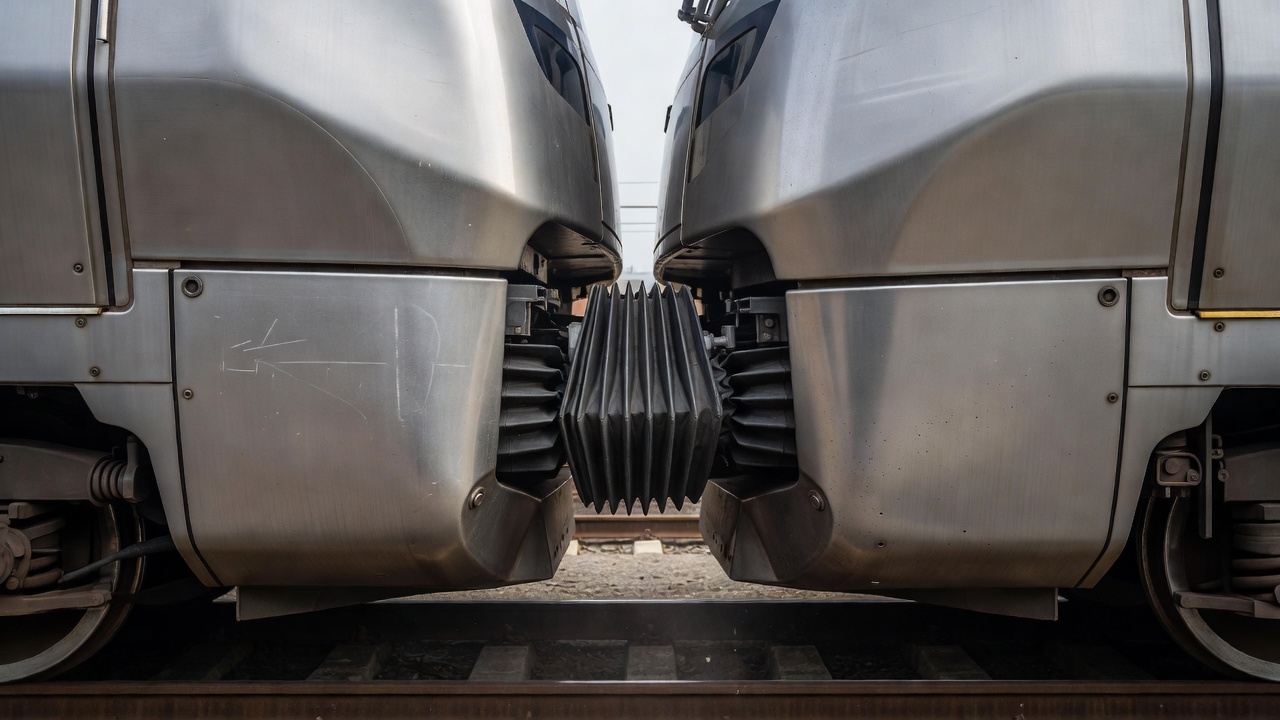
Inter-car gaps must allow relative movement through curves, suspension travel and coupling tolerances. Aerodynamically, an exposed gap can behave as a cavity: a shear layer spans the opening while recirculating flow develops within it. That flow can interact with the downstream edge. Depending on geometry and conditions, the result can include fluctuating loads and noise. Flexible fairings can help, but they must withstand movement, weather and repeated maintenance.
The same cause-and-effect reasoning applies to recessed doors, exposed steps and other discontinuities. The relevant question is not whether every surface is perfectly flush, but whether a proposed change improves the required performance without creating a worse operational problem. A small geometric adjustment may reduce a local tone while barely changing total train drag. Conversely, a modest distributed improvement repeated along the train may matter substantially to resistance.
| Region | Flow mechanism | Practical check |
|---|---|---|
| Body skin | Wall shear in the boundary layer | Surface condition and train length |
| Bogie recess | Separation and turbulent mixing | Cooling, suspension and debris clearance |
| Pantograph | Unsteady component wakes | Current collection and uplift |
| Inter-car gap | Cavity and shear-layer interaction | Articulation and durability |
| Tail | Pressure recovery and wake formation | Slipstream and rear-end geometry |
The tail inherits everything upstream
Near the tail, the body contracts and the flow adjusts towards the space left behind. Pressure recovery and separation help determine the wake structure and the rear contribution to drag. Although many passenger trainsets have similar-looking ends for bidirectional operation, the leading and trailing ends experience very different incoming flows. At the rear, the boundary layer has developed along the entire train and may be strongly non-uniform.
The wake also matters beyond energy use. Trackside slipstreams can affect people and objects near the railway, and measurements depend on position, height, train configuration and repeated-run variability. EN 14067-4 addresses aerodynamic assessment on open track; it is not simply a guide to drawing a streamlined shape. Slipstream assessment is one reason that full-scale testing remains important alongside calculations and reduced-scale experiments.
Read a vehicle as a connected system
The Deutsche Bahn ICE 3, Siemens Velaro and Alstom AGV are useful real-world references for examining how vehicle architecture and exposed equipment differ. Their photographs can help identify features, but reliable comparison requires matched definitions and conditions. Do not infer a resistance ranking from visible smoothness alone. Ask where the measured force acts, what flow reaches the component, and what requirement the proposed change must still satisfy.
- CEN-CENELEC — source organisation for the EN 14067 railway aerodynamics standards family; consult the applicable edition.
- German Aerospace Center, DLR — research context for transport aerodynamics and experimental methods.
- Alstom rolling stock — vehicle architecture and high-speed train context.
- Railway Technical Research Institute — aerodynamic noise and railway environmental research.