Why the wave gets there first
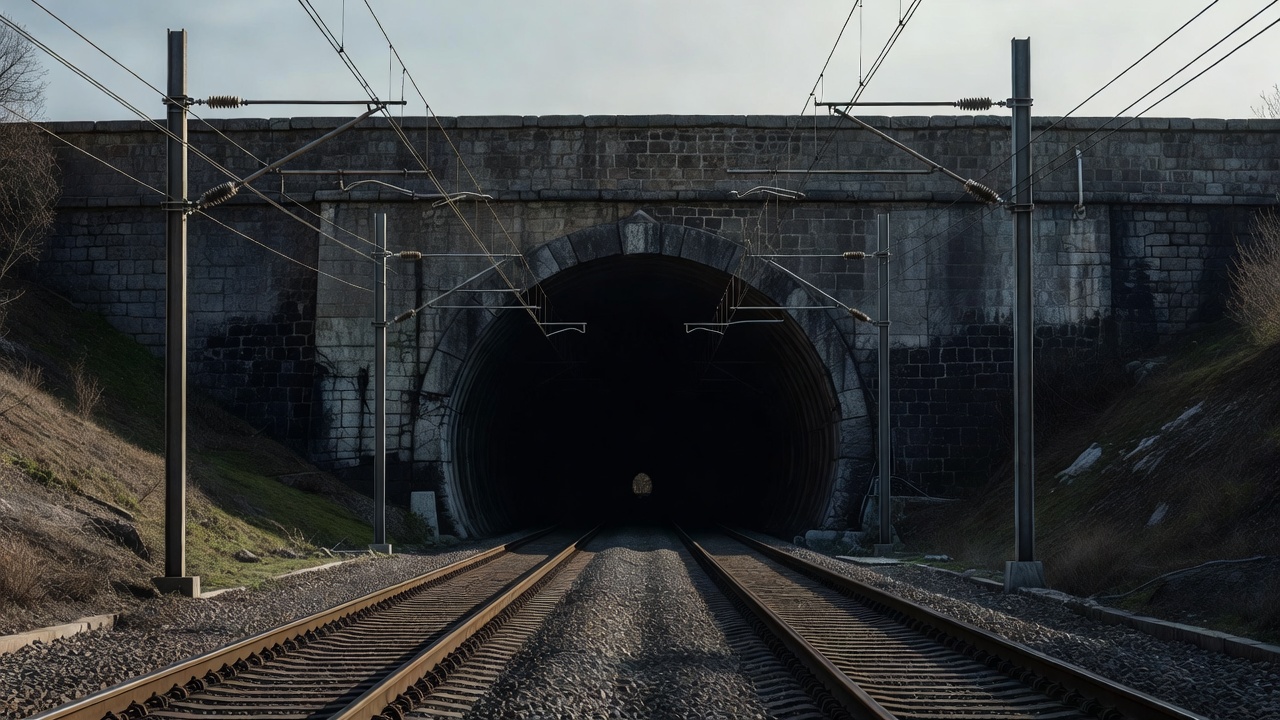
When a high-speed train enters a tunnel, its growing cross-section displaces air into a space with limited escape routes. A compression wave forms and travels along the bore. The wave is a moving pressure disturbance, not a plug of air carried at train speed. Under ordinary railway conditions it propagates at approximately the local acoustic wave speed, modified by the flow and tunnel environment, so it reaches downstream locations before the train.
This distinction explains why a pressure sensor far inside a tunnel can respond while the train is still near the entrance. The air particles undergo local changes in pressure, density and velocity as the wave passes; they do not all travel the length of the tunnel with it. Later events, including the entry of the tail, reflections from openings and the train’s continuing motion, create additional disturbances.
Blockage is a useful starting ratio
The blockage ratio is commonly described as the train cross-sectional area divided by the tunnel cross-sectional area. It captures how much of the available section the vehicle occupies. Greater blockage generally makes confinement more important, but the ratio is not a complete prediction. Two tunnels with the same ratio can differ in length, shape, roughness, shafts, portal geometry and track arrangement. Those differences change the unsteady flow and pressure history.
Nose geometry also matters because the full train area does not appear at the portal instantaneously. The nose introduces it over time. A longer, suitably shaped transition can reduce the abruptness of the initial pressure rise under specified conditions. This links vehicle design directly to infrastructure. It also explains why a tunnel-optimised nose is not adequately described by a single length measurement or a visually pointed tip.
What happens at the far portal?
As the compression wave travels, its shape can change through competing nonlinear steepening and dissipative processes. When it reaches an exit, part of its energy radiates into the outside air. A sufficiently abrupt wavefront can generate a noticeable micro-pressure wave outside the portal. This phenomenon is often called tunnel boom, although the train itself is travelling far below the speed of sound. A supersonic train is not required.
The initial entry gradient is important, but so is what happens during propagation. Tunnel length and wall conditions can influence the arriving wavefront. Consequently, one cannot reliably estimate the outside event from train speed or nose length alone. Railway Technical Research Institute work on Shinkansen tunnels is a useful starting point for seeing the problem treated as a coupled vehicle-and-infrastructure system rather than a styling issue.
Different measures act at different stages
An entrance hood can distribute the initial air displacement through an extended or vented transition. Nose shaping changes how the vehicle area is introduced. A larger tunnel cross-section changes confinement. Shafts or other pressure-relief arrangements alter how disturbances propagate and interact. These measures are not interchangeable, and an effective combination must be assessed for the actual route, including nearby receptors and operating patterns.
Operational choices also matter. A speed restriction can change pressure-wave severity, but it affects journey time and capacity. A tunnel system used by several vehicle types cannot be designed around the photograph of a single ideal train. Engineers examine the intended range of train lengths, cross-sections and speeds, as well as credible combinations of meeting and entry events. Route-level compatibility is more informative than a universal “best nose” claim.
| Question | Relevant quantity | Where to investigate |
|---|---|---|
| How abrupt is entry? | Initial pressure rise and time gradient | Nose, portal and entrance hood |
| What radiates outside? | Wavefront reaching the exit and external response | Tunnel propagation and exit surroundings |
| What do passengers experience? | Cabin pressure history and rate of change | External loading, sealing and ventilation |
The cabin filters the outside event
A pressure disturbance outside the vehicle is not reproduced instantly or identically inside. Body sealing, leakage paths and the ventilation system influence the cabin response. Pressure management can reduce rapid internal changes, but it must coexist with fresh-air requirements and normal system operation. Passenger comfort therefore requires the cabin pressure history, not just an isolated measurement of peak pressure beside the train.
Infrastructure and vehicle structural assessments ask related but different questions. External pressure loads act on the body, windows, doors and fittings. Repeated events can matter as well as individual peaks. EN 14067-5 provides a framework for assessment procedures and test requirements for aerodynamics in tunnels. Actual compliance work requires the applicable standard, route requirements and competent assessment; this atlas is an introduction, not a substitute for them.
A crossing is another unsteady interaction
When two trains pass, their surrounding pressure fields interact and create short-lived changes on each vehicle. In a tunnel, those events occur alongside waves already travelling through the confined space. The timing, lateral clearance, train geometry and relative motion affect the resulting history. Treating a crossing as simply “twice the speed, twice the pressure” misses both the fluid mechanics and the difference between force magnitude and event duration.
The practical lesson is to draw a timeline before reaching for a single number: nose entry, wave arrival, reflection, train meeting, tail entry and exit may occur at different times. Once those events are distinguished, the engineering questions become clearer. Which pressure change matters, where is it measured, and what vehicle or infrastructure feature can influence it?
- Railway Technical Research Institute, Environmental Engineering — tunnel micro-pressure-wave research context.
- CEN-CENELEC — EN 14067-5, requirements and assessment procedures for aerodynamics in tunnels.
- Eurostar and the Getlink Group — real-world context for high-speed services and Channel Tunnel infrastructure, not a source of universal design values.